

Table of Contents
- Methodology: How We Ranked the Agencies – Our research-led scoring framework.
- The 5 Pillars of 2026 Transformation – Strategic foundations for resilient growth.
- Comparative Performance Matrix – Scoring across the four core dimensions.
- 2026 Transformation Landscape – Assurance signals, ESG, and budget ranges.
- The Top 10 Agency Overviews – Detailed profiles and “Agentic” edges.
- A Helpful Glossary of Terms – Helpful definitions for marketing stakeholders.
- Frequently Asked Questions (FAQs) – Addressing common board-level concerns.
Methodology: How We Ranked the Leading Agencies
Our 2026 assessment evaluates how agencies perform in a landscape where Answer Engine Optimisation (AEO) and Sovereign Data have emerged as the new benchmarks for digital success. To move beyond surface-level reviews, we adopted a research-led framework that looks past creative output to focus on the technical and operational foundations of each firm.
The Core Evaluation Framework
We assessed each agency against two critical future-proofing requirements:
- Answer Engine Optimisation (AEO): As traditional search gives way to AI-driven “Answer Engines” (such as Perplexity and Gemini), we measured an agency’s ability to restructure brand data. The highest scores went to agencies that move beyond keywords to build “machine-readable” data layers that AI agents can trust and surface.
- Sovereign Data Integrity: With the Data (Use and Access) Act 2025 now in full force, we prioritised agencies with proven expertise in UK data residency and regional cloud architectures. This ensures that a brand’s digital growth is both legally compliant and operationally resilient.
Rigorous Inclusion & Scoring
To ensure our recommendations carry real-world weight, all candidates were vetted against strict inclusion criteria:
- Operational Stability: Agencies must maintain a permanent UK workforce and a demonstrated ability to deliver “Scale” transformations (programmes exceeding £1m).
- Vetted Status: Candidates must be active on recognised UK frameworks, such as G-Cloud 15, confirming they meet high-level security and procurement standards.
The Four Scoring Dimensions
Each agency was scored out of 100 based on the following weighted pillars:
- Data & Agentic AI Maturity: Their ability to build autonomous “Agentic Workflows” that handle complex tasks, rather than just basic chatbots.
- Unified UX/CX Quality: How well the agency merges disparate digital touchpoints into one seamless, high-quality user journey.
- Operating Model Change: Their success in upskilling client teams, ensuring the organisation isn’t left dependent on the agency long-term.
- Strategic ROI: Their track record of linking technical infrastructure directly to business KPIs, such as Customer Acquisition Cost (CAC) and Lifetime Value (LTV).
Evidence and Data Synthesis
Our rankings are not based on opinion but on a synthesis of industry-leading data sources:
- Public Procurement Data: We analysed spend and contract awards via the Crown Commercial Service (CCS) to verify project scale.
- Analyst Reports: We integrated insights from the Gartner Magic Quadrant and IDC MarketScape 2026 reports.
- The Evidence Standard: We prioritised publicly verifiable case studies and recognised certifications. Where specific data was private, we used directional assessments—evaluating the sophistication of the technology and the maturity of the implementation.
This balanced approach ensures our Top 10 list represents agencies that are technically capable, secure, and commercially focused for the 2026 digital economy.
The 5 Pillars of Digital Transformation in 2026
- Pillar 1: Infrastructure and Cloud Modernisation: Shifting from legacy hosting to composable, API-first architectures that allow marketing teams to swap tools in weeks rather than years.
- Pillar 2: Data Governance, Sovereignty, and Intelligence: Implementing agentic workflows while ensuring alignment with the Data (Use and Access) Act 2025.
- Pillar 3: Cyber Resilience and Secure-by-Design: Integrating security through Zero Trust patterns and independent security assurance (for example, CHECK-aligned penetration testing where appropriate) to protect brand reputation proactively.
- Pillar 4: Unified Customer Experience (CX): Consolidating fragmented estates to enable predictive engagement across all digital touchpoints.
- Pillar 5: Operating Model and Change: Focusing on product ownership and internal upskilling to eliminate vendor-dependency.
What “good” looks like in 2026: the strongest programmes align architecture, data governance, and security with measurable customer outcomes, then sustain them through service ownership, training, and adoption.
2026 UK Transformation Landscape: Comparative Overview
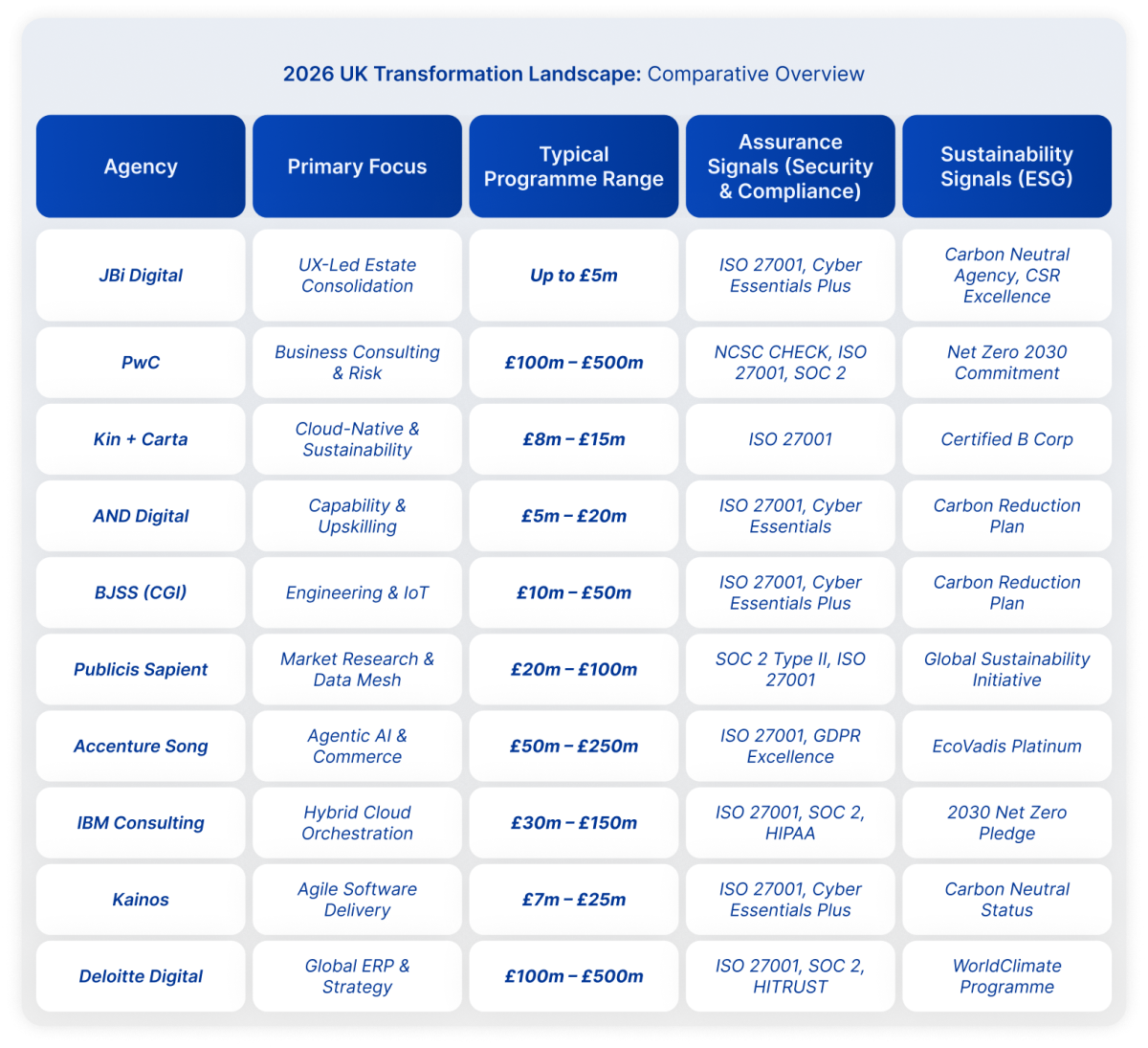
Agency Overviews
1. JBi Digital
The Pitch: JBi Digital is the high-agility choice for enterprise-grade UX and the consolidation of fragmented digital estates. For brands that have disparate websites and legacy backends, JBi Digital builds secure and unified premium experiences that marketing managers require without “Big Four” overheads. The firm bridges the gap between high-level consultancy and rapid boutique execution, making it a primary choice for large organisations requiring premium UX overhauls backed by secure, UK-sovereign infrastructure.
Core Services: UX/UI Design Strategy, Digital Estate Consolidation, Legacy Modernisation, and Secure API Integration.
2026 “Agentic” Edge: The agency leads in Legacy Wrapping, building secure API layers that allow modern AI agents to interact with legacy databases, enabling immediate AI-driven customer service without a total “rip and replace.”
Typical Engagement: End-to-End Partnership. The firm typically leads with an eight-week Discovery (UX Audit), followed by agile Delivery, and offers a Fully Managed Service for Sovereign Cloud hosting.
Methodology Scorecard: High scores in Unified UX/CX and AEO Readiness due to their schema-first architectural approach.
Transformation Proof: For Ofwat, JBi Digital transformed a complex public data estate into a secure, user-centric platform, modernising the interface whilst maintaining strict compliance.
Key Success Factor: Your team should be empowered to make decisions quickly during delivery, so momentum continues after launch.
2. PwC
The Pitch: PwC represents the ultimate “safe hands” for highly regulated transformation. The firm is the partner of choice when a board requires absolute assurance that a multi-million-pound shift will not lead to a regulatory fine or a data breach. PwC treats technology as a subset of broader business risk, making it indispensable for the banking and energy sectors where digital failure carries national consequences.
Core Services: Business Case Modelling, AI Governance, Enterprise Cloud Strategy, and NCSC-aligned Cyber Security.
2026 “Agentic” Edge: The firm specialises in AI Governance, providing the frameworks that ensure AI agents operate within the legal bounds of the Data (Use and Access) Act 2025.
Typical Engagement: Strategic Managed Service. PwC is often engaged for high-level Discovery and Managed Capacity models, overseeing long-term corporate functions.
Methodology Scorecard: Exceptional scores in Sovereign Data Integrity and Operating Model Change due to their deep boardroom presence.
Transformation Proof: The firm supported major global banks in migrating legacy core systems while maintaining NCSC CHECK status for military-grade penetration testing.
Key consideration: Larger programmes can involve more governance and approvals, so agree early how decisions will be made and how fast delivery needs to move.
3. Kin + Carta (Part of Valtech)
The Pitch: Kin + Carta is the recognised leader in sustainability. The agency balances high-performance cloud engineering with Green IT. For Marketing Directors with ESG targets, this partner ensures that digital growth does not compromise the corporate carbon footprint. It is a premier choice for global brands looking to align their technical stacks with ethical, responsible, and sustainable outcomes.
Core Services: Cloud-Native Development, Data Engineering, Responsible AI Automation, and Sustainable Tech Audits.
2026 “Agentic” Edge: The firm pioneers Responsible AI, building automated systems with built-in bias detection to ensure marketing campaigns remain ethical and brand-safe.
Typical Engagement: Product Delivery & Scaling. Kin + Carta is known for high-velocity Delivery of cloud-native platforms, transitioning into Managed Services focused on continuous data optimisation.
Methodology Scorecard: High scores in Strategic ROI through cloud-native optimisations that reduce energy consumption and operating costs.
Transformation Proof: The agency developed a global, sustainable data platform for Unilever, reducing energy consumption whilst improving global supply chain visibility.
Point to note: Sustainability targets work best when they’re turned into clear technical rules (for example performance budgets, hosting standards, and measurement), not just principles.
4. AND Digital
The Pitch: AND Digital acts as an “Internal Growth” engine. The firm is designed for Marketing Managers seeking to avoid vendor lock-in. Its “Club” model focuses on co-delivery, building new applications while simultaneously training the client’s team to take ownership. The agency addresses the digital skills gap head-on, ensuring that by the end of the engagement, the internal team possesses the capability to innovate independently.
Core Services: Agile Product Delivery, Digital Upskilling, Tech Talent Strategy, and CX Design.
2026 “Agentic” Edge: The agency focuses on Citizen AI Development, empowering non-technical marketing staff to build their own “mini-agents” for routine tasks.
Typical Engagement: Co-Delivery & Enablement. The firm specialises in integrated Delivery squads. The engagement is designed to “build and bolt,” leaving the client with a fully trained internal workforce.
Methodology Scorecard: Top marks for Operating Model Change success, verified through their “build and bolt” hand-over model.
Transformation Proof: The firm partnered with British Airways to accelerate digital product delivery while upskilling hundreds of internal staff in agile methodologies.
Key Success Factor: Your team can commit time to co-delivery and training, with clear internal ownership, so capability genuinely transfers.
5. BJSS (CGI)
The Pitch: BJSS is the “Mission Critical” authority that handles projects that cannot fail. From the NHS App to national energy grids, the firm provides the engineering muscle for the UK. It focuses on resilience, high-traffic handling, and “Hard-Hat” technical engineering, making it the preferred partner for Critical National Infrastructure (CNI) and logistics.
Core Services: High-Performance Engineering, IoT Development, Managed Services, and Cloud Resilience.
2026 “Agentic” Edge: The firm leads in Industrial IoT Intelligence, using AI agents to monitor physical infrastructure in real time to predict failures before they occur.
Typical Engagement: Engineering Delivery & “Run.” BJSS excels at complex Discovery followed by rigorous Delivery. The agency’s Managed Service provides 24/7 proactive monitoring.
Methodology Scorecard: Leading scores in Sovereign Data and technical Scalability for Critical National Infrastructure.
Transformation Proof: The agency re-engineered the backend of the NHS App, enabling it to handle millions of users with 99.99% uptime and NHS-grade data security.
Strategic insight: Engineering-heavy programmes benefit from strong product and service design input, so the user experience keeps pace with the tech.
6. Publicis Sapient
The Pitch: Publicis Sapient is an “Insights-to-Impact” partner. The agency specialises in Digital Business Transformation by using deep consumer research to dictate technical architecture. It ensures that a technical overhaul actually improves customer satisfaction and market share, blending the speed of a startup with the scale of a global powerhouse.
Core Services: Data Mesh Architecture, AI-Driven Consumer Research, and Omni-channel Experience Design.
2026 “Agentic” Edge: The firm demonstrates mastery of Data Mesh Architecture, helping managers turn stagnant data silos into reusable “data products” that power hyper-personalisation.
Typical Engagement: Transformation Roadmap. The firm leads with a heavy Discovery phase (Digital Transformation Index), followed by iterative Delivery of disruptive solutions.
Methodology Scorecard: High AEO Readiness scores for their work in making enterprise data layers “machine-readable.
Transformation Proof: The agency retooled Marriott’s digital ecosystem to act with startup speed, using data-driven insights to fuel a global loyalty platform.
Key consideration: Discovery is valuable, but agree upfront how insights will translate into a delivery plan, milestones, and measurable outcomes.
7. Accenture Song
The Pitch: Accenture Song is a “Creative-Scale” powerhouse. The agency merges world-class creative flair with the industrial data-processing power of the wider Accenture group. It is an ideal choice for massive retail brands seeking to lead in “experience-led growth,” using AI to create immersive, personalised shopping journeys across multiple markets simultaneously.
Core Services: Agentic Commerce Workflows, Generative AI Production, and Global Commerce Strategy.
2026 “Agentic” Edge: The agency is a global pioneer of Agentic Commerce, building AI systems that autonomously manage customer engagement and inventory rather than merely recommending products.
Typical Engagement: Outcome-Based Managed Service. The firm operates at the industrial layer, often taking on Managed Services for entire marketing or customer service operations.
Methodology Scorecard: Top scores for Strategic ROI and Agentic AI Maturity at a global scale.
Transformation Proof: The agency delivered a multi-market commerce transformation for Sephora, unifying the experience across 35 countries to drive global LTV.
Point to note: You’ll get the most value when commercial KPIs, data governance, and ownership are agreed early, so “experience improvements” convert into business impact.
8. IBM Consulting
The Pitch: IBM Consulting is a “Hybrid-by-Design” architect. The firm is the partner of choice for modernising across complex, distributed IT estates spanning multiple clouds and on-premise servers. It provides the technical “muscle” for global manufacturing and logistics firms that require AI to work reliably in local factories and global clouds alike.
Core Services: watsonx AI Orchestration, Hybrid Cloud Management, and Quantum-Safe Security.
2026 “Agentic” Edge: The firm utilise watsonx AI Orchestration, enabling “AI at the Edge” so agents can run securely on local servers for low-latency industrial tasks.
Typical Engagement: Co-Creation (IBM Garage). The firm uses the “IBM Garage” model for rapid Discovery and Delivery, moving into Application Managed Services for hybrid cloud.
Methodology Scorecard: Exceptional Sovereign Data Integrity scores and leadership in secure hybrid-cloud environments.
Transformation Proof: The firm partnered with Maersk to digitise global supply chains using secure, hybrid-cloud logistics platforms and real-time tracking.
Key consideration: There’s a clear plan for integration (APIs, identity, monitoring) and a clear operating model for who runs what after go-live
9. Kainos
The Pitch: Kainos is a “Citizen-Centric” specialist. The firm is a staple for the UK Public Sector, possessing a deep understanding of GDS standards and large-scale Workday integrations. It is the primary partner for government departments needing to modernise citizen outcomes through agile, secure, and accessible digital delivery.
Core Services: GDS-Compliant Service Design, Workday Implementation, and Automated Testing (Smart Test).
2026 “Agentic” Edge: The firm masters Secure Automated Testing, ensuring government-grade software is released without bugs through AI-driven, high-velocity testing cycles.
Typical Engagement: Agile Lifecycle. The agency provides the full GDS lifecycle: Discovery, Alpha, Beta (Delivery), and Live (Managed Service).
Methodology Scorecard: High scores in G-Cloud 15 transparency and compliance with accessibility standards.
Transformation Proof: The firm developed the Driving Examiner Service for the DVSA, moving a manual process into a highly secure, mobile-first digital workflow.
Key success factor: Public sector delivery is smoother when accessibility, service standards, and data-sharing constraints are agreed early across teams and departments.
10. Deloitte Digital
The Pitch: Deloitte Digital is a “Strategy-Led” integrator. The firm excels at translating boardroom goals into global technology implementations and total “core” transformations. It is the partner for FTSE 100 firms undergoing massive shifts in ERP or digital identity systems where the goal is total business-wide modernisation.
Core Services: SAP S/4HANA & Oracle Cloud Integration, Digital Identity Management, and Board-level Digital Advisory.
2026 “Agentic” Edge: The firm leads in Digital Identity Strategy, building biometrically secure access layers to protect corporations from AI-driven “deepfake” security threats.
Typical Engagement: Global Programme Management. The firm typically manages massive, multi-year Delivery programmes, providing the Managed Services required to run global business systems post-launch.
Methodology Scorecard: Strong scores in Operating Model Change and large-scale Strategic ROI for FTSE 100 firms.
Transformation Proof: The firm led the global SAP S/4HANA implementation for several of the world’s largest insurance groups, modernising finance systems across multiple continents.
Point to note: Large global programmes benefit from clear scope boundaries and phased releases, so value is delivered along the way rather than only at the end.
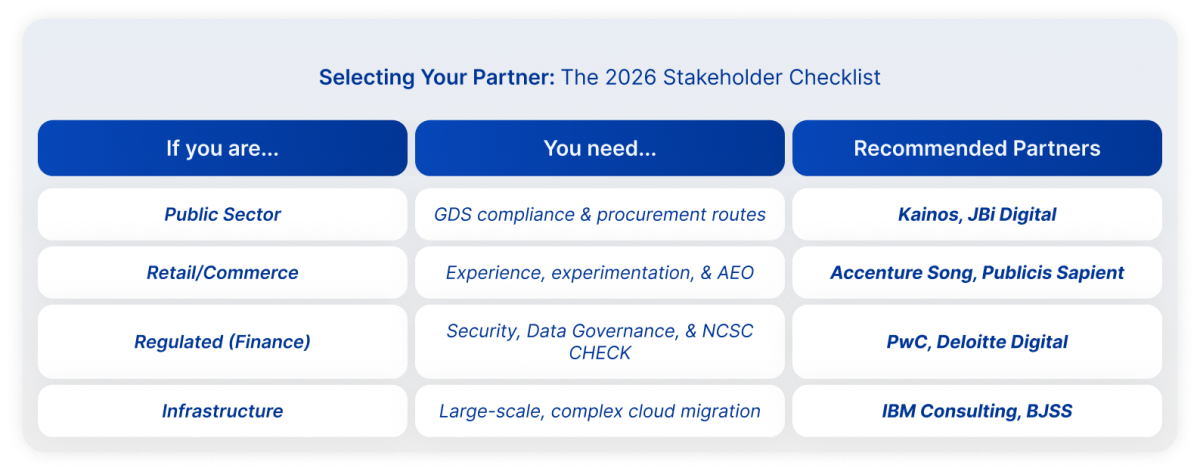
Selecting Your Partner: The 2026 Stakeholder Checklist
Is your digital roadmap future-proof?
At JBi Digital, we provide bespoke strategic audits for enterprise and public sector organisations. We help you identify gaps in your current digital estate and build a pragmatic, secure, and modern path forward.
We can also provide a vendor-neutral audit format on request, so you can use the output with any delivery partner.
Please note: Rankings are based on the methodology provided using publicly available information; where public evidence was limited, we avoided making definitive claims.
Frequently Asked Questions (FAQs)
These questions address the most common concerns raised by CMOs, Digital Directors, and transformation leads when evaluating digital transformation partners in 2026.
Q: What is Sovereign Data?
A: Sovereign Data refers to information that is subject to the laws and governance structures of the country where it was collected. It ensures that an organisation retains absolute control over its data, dictating exactly where it resides and who may access it. For a UK-based entity, this means ensuring that sensitive customer or corporate information is stored on servers within British borders, protected by UK legal standards, rather than being scattered across international jurisdictions where privacy protections might be inferior.
Q: Why has AEO replaced traditional SEO as the gold standard for a modern digital presence?
A: In 2026, the way people find information has fundamentally changed. While traditional SEO was designed to entice users to click a link and visit a website, Answer Engine Optimisation (AEO) prepares your business for a world of AI assistants and voice search.
Instead of merely chasing clicks, AEO organises your company’s information so clearly that AI tools can understand and trust it. This ensures that when a customer asks a question, the AI provides your specific, verified answer directly. Success in this area proves that your brand has moved beyond simple web pages and has become the definitive source of truth that AI models rely upon.
Q: Following the Data (Use and Access) Act 2025, why is Sovereign Data now a non-negotiable for marketing compliance and security?
A: By adopting a Sovereign Data approach, a Marketing Team ensures that customer information is stored within the UK, shielded from the complexities of foreign laws and international data meddling. This structure provides a formidable layer of protection against cyber threats, as it eliminates the risks associated with storing sensitive brand assets on disparate global servers. Essentially, it allows your business to utilise powerful global AI tools while ensuring your data stays firmly under British protection and remains fully compliant with domestic privacy standards.
Q: What is Legacy Wrapping?
A: Legacy Wrapping is a strategic method of modernising your digital capabilities without the upheaval of a total system overhaul. Imagine your current, older database as a reliable but dated engine; rather than replacing the entire machine, we build a sophisticated, modern “shell” around it.
This shell, technically known as an API layer, acts as a bridge, allowing your established systems to communicate fluently with the latest technologies. It enables you to launch cutting-edge websites, mobile apps, and AI-driven tools that look and feel brand new to your customers, while the data remains safely housed in the systems your business already knows and trusts. It is a way to gain the benefits of the latest digital transformation while avoiding the immense cost and disruption of starting from scratch.
Q: How does a “Legacy Wrapping” approach differ from a traditional “Rip and Replace” overhaul?
A: A traditional “rip and replace” involves decommissioning your entire existing system and building from scratch, a process that is often high-cost and high-risk. Legacy Wrapping is a more pragmatic alternative; we build a modern API layer (the “wrapper”) around your existing databases. This allows you to deploy modern AI tools and premium user experiences immediately, without the downtime or risk associated with a total core migration. This approach reduces delivery risk, accelerates time-to-value, and preserves business continuity.
Q: With the 2026 focus on AEO, is our traditional website still relevant?
A: Absolutely, while Answer Engine Optimisation (AEO) ensures that AI agents can find and trust your brand’s facts, your website remains the primary destination for high-intent customers who seek a deeper brand experience. Think of AEO as the “concierge” that introduces the customer to your brand, and your website as the “flagship store” where the relationship is solidified and the transaction occurs.
Q: How does the Data (Use and Access) Act 2025 impact my choice of a transformation partner?
A: This legislation mandates stricter controls on how UK citizen data is handled and accessed. It is essential to choose a partner with a deep understanding of Sovereign Data and UK residency. Agencies that primarily outsource development to jurisdictions with different data protections may inadvertently expose your brand to significant legal and financial liability. In practice, this means clear controls over where data is stored, who can access it, how it is audited, and how AI systems are allowed to interact with it.
Q: Why is “Operating Model Change” included in the agency scoring?
A: We have found that the most successful transformations are those that leave the client’s team stronger. If an agency delivers a world-class platform but doesn’t upskill your internal staff, you become “locked in” to that vendor for every minor update. We score agencies on their ability to transition capability back to you, ensuring your team has the autonomy to innovate post-launch.
Q: What is the typical “Time-to-Value” for a digital estate consolidation?
A: While a full estate consolidation can take twelve to eighteen months, we recommend a Phased Delivery model. By focusing on a “Proof of Value” (PoV) or a specific high-impact site first, “well-structured programmes typically show measurable improvements in site speed, security, or conversion within the first eight to twelve weeks.
Q: How can we justify the investment in “Zero Trust” security to the board without getting lost in technical jargon?
A: In 2026, cybersecurity has evolved from a hidden IT expense into a primary brand asset. A “Zero Trust” approach is essentially a modern insurance policy for your corporate reputation. Unlike older systems that trusted anyone once they were “inside” the office network, Zero Trust verifies every single request for information, every single time.
When presenting this to the board, it is most effective to frame the cost as Brand Protection. A high-profile data breach is not just a technical glitch; it is a public event that can plummet share prices and erode customer loyalty overnight. By positioning Zero Trust as a strategic necessity for Regulatory Compliance, you demonstrate that this investment is about securing the organisation’s long-term valuation and ensuring that the brand remains a trusted leader in a volatile digital world.
Q: Can a smaller “boutique” agency handle the same scale as a global consultancy?
A: For most mid-to-large UK enterprises, a boutique agency is often more effective. While global firms have massive headcounts, boutique agencies provide direct access to senior strategists and more agile delivery cycles. The key is to check for Assurance Signals (like ISO 27001 and G-Cloud status) and experience of digital transformation programmes, which prove the agency has the rigorous frameworks required for enterprise-grade work.
Q: Is “Sustainability in Tech” just a box-ticking exercise for ESG reports?
A: Not at all. Sustainable Tech is often synonymous with Efficient Tech. A sustainable audit identifies bloated code and inefficient server usage. By “cleaning” your digital estate, you not only reduce your carbon footprint but also improve site performance and reduce hosting costs—a rare “win-win” for both the planet and the P&L.
Q: What evidence should we ask for when selecting a digital transformation agency?
A: Buyers should look for publicly verifiable evidence such as named case studies, recognised certifications (for example ISO 27001), framework participation (such as G-Cloud), and clearly documented delivery approaches. Strong partners can also articulate how outcomes were measured, not just what was delivered. Clear evidence of successful digital transformation programmes is also essential.
Q: How can we tell if an agency is genuinely “AI-ready” and not just using AI as a buzzword?
A: An AI-ready partner will move beyond the surface-level features of specific tools. They should be able to explain how AI integrates with your existing data models, governance structures, and internal operating procedures. A significant warning sign is a preoccupation with “generative” tools that lacks a foundational data strategy. Without a robust plan for human oversight and data integrity, any AI implementation is a liability rather than an asset.
Q: What is the difference between AEO and traditional SEO in practical terms?
A: Traditional SEO focuses on the aesthetics and keywords required to rank highly in search engine results. Conversely, Answer Engine Optimisation (AEO) is about the clarity and structure of your corporate facts. It ensures that the relationships between your data points are so well-defined that AI systems can extract and serve them as “trusted answers.” In short, while SEO seeks to get a user to your website, AEO ensures your brand is the definitive answer, regardless of where the user is searching.
Q: Does digital transformation always require a full replatform or ERP replacement?
A: No. Many successful programmes prioritise integration, consolidation, and phased modernisation over full replacement. This reduces risk, protects business continuity, and allows organisations to realise value earlier while planning longer-term platform change.
Q: Who should be the internal champion for a digital transformation initiative?
A: For a programme to truly take root, it requires a cross-functional alliance rather than being siloed within a single department. While executive sponsorship is vital, the most effective initiatives feature shared accountability between Marketing, Technology, and Operations. Without this combined ownership, even the most advanced platforms will fail to evolve alongside the business after the initial launch.